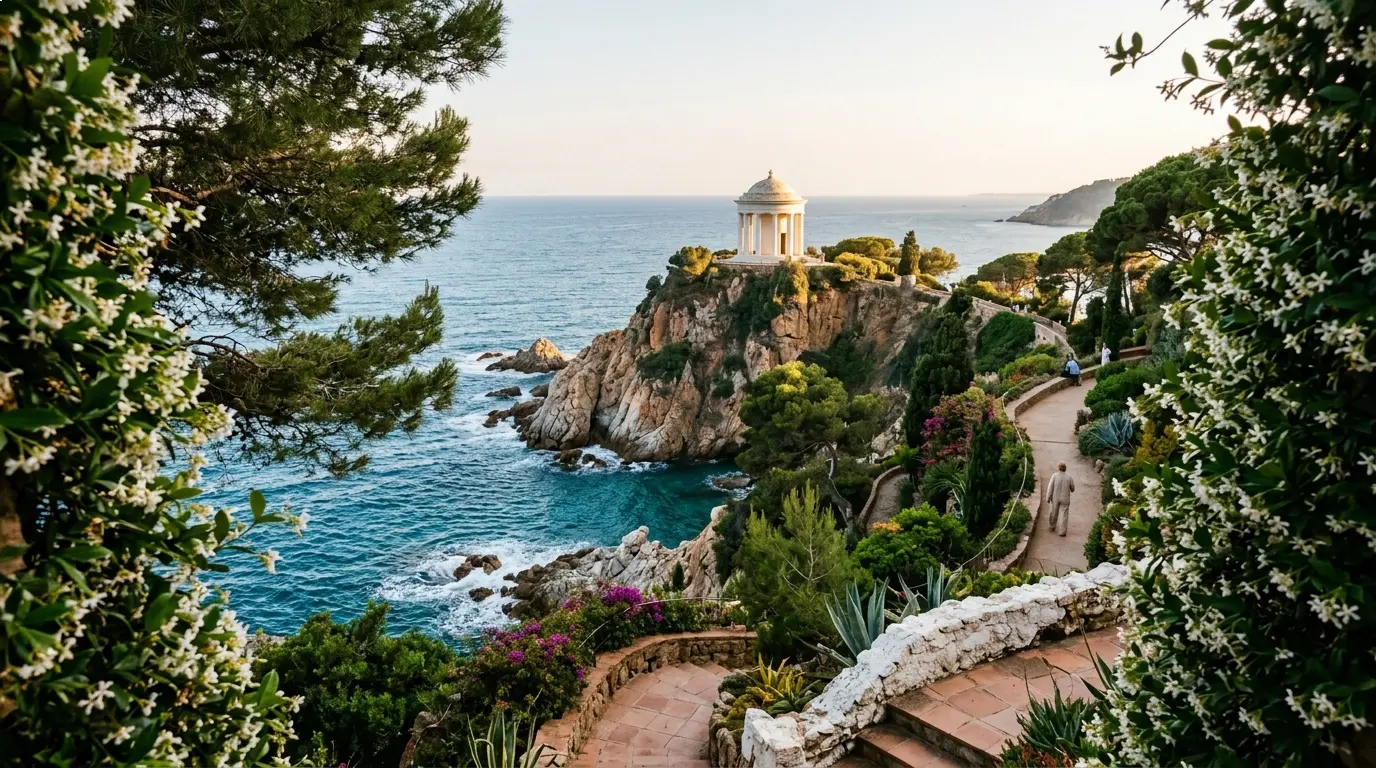
There is a certain hour in the Costa Brava spring when the air fills with the resinous scent of the pines, and below the cliffs the water glows like turquoise. Years ago, during a particularly hectic season, I fled for the first time up above Blanes, to a garden suspended over the sea — and there, between the palms and the endless ocean, I understood that the true luxury of the Costa Brava is not the coastline, but the silence the gardens keep. These are not tourist attractions. They are living sanctuaries, where the centuries-old dialogue between plant, stone and light teaches us, once again, how to breathe.
The philosophy of "mar i muntanya"
One of Catalan cuisine's most famous notions, mar i muntanya — "sea and mountain" — is the idea that seemingly opposing forces together create perfect harmony. The botanical gardens of the Costa Brava are the tangible embodiment of this philosophy. Here, Mediterranean limestone cliffs, the salt-laden sea breeze and flora gathered from every corner of the world melt into a single, breathing whole.
When I accompany my guests into these gardens, I always ask the same of them: come not to photograph, but to arrive. A garden is not an experience to be consumed; it is a slow conversation, one we must give ourselves the time to have.
Marimurtra – on the cliff's edge, where silence teaches
Above Blanes, perched on a steep rock face, lies the Jardí Botànic Marimurtra, dreamt into being by the German businessman and patron Karl Faust in the early 20th century. It is home to more than four thousand plant species, from the austere beauty of cacti to the lush green of a subtropical grove.
The heart of the garden is its neoclassical pergola, the Temple of Linné, from which the gaze plunges down to the turquoise cove of Cala Forcanera. It is no coincidence that here, one falls silent. The very scale of the landscape is meditative: the endless horizon reminds us that the real proportions of our daily worries are far smaller than they feel.
"A garden does not show us how beautiful the world is. It teaches us how to look at it — slowly, patiently, and without ever wishing to possess any of it."
Santa Clotilde – the serenity of geometry
Above Lloret de Mar, a wholly different mood awaits. The Gardens of Santa Clotilde are a masterpiece of the Noucentista style, designed in 1919 by the young architect Nicolau Maria Rubió i Tudurí in the spirit of the Italian Renaissance garden. Here it is not wild botanical variety that reigns, but form, proportion and perspective.
Cypress-lined stairways, moss-covered statues and secret viewpoints opening onto the sea create an order that soothes the overburdened mind. Psychologists call this "soft fascination": beauty draws the attention so gently that it replenishes, rather than depletes, our mental reserves.
The science of garden therapy
What the Catalans know by instinct, research now confirms. The Western counterpart of the Japanese practice of Shinrin-yoku — "forest bathing" — can be lived precisely in gardens such as these. The volatile compounds released by plants, the phytoncides, have been shown to lower levels of cortisol, the stress hormone, to slow the pulse and deepen the breath.
A slow walk through the gardens of Cap Roig near Calella de Palafrugell, or a quiet hour on the benches of Marimurtra, is not merely a pleasant pastime. It is measurable, physiological healing: our nervous system finds its way back to that parasympathetic, "rest and digest" state from which urban life so often tears us away.
How to experience a "slow" garden visit
The essence of Quiet Luxury is to give ourselves our most precious resource — time and presence. Here is some advice on how to turn a garden visit into genuine therapy:
- Arrive early. The morning light is soft, the gardens are empty, and birdsong still fills the air.
- Keep the phone in your pocket. Let the details — a drop of dew, the path of a bee — find your gaze of their own accord.
- Sit down at least once. A garden truly opens only when we come to a stop. Ten still minutes give more than an hour of walking.
- Breathe consciously. Take a deep breath and name to yourself what you sense: the scent of pine, of salt, of damp earth.
On SpainAura's programs we do not simply take you to a garden. We teach the art of slowing down, so that every visit becomes a quiet retuning of the soul.
Would you like to experience the healing power of the Mediterranean way of life for yourself? Discover the hidden gardens of the Costa Brava and the art of slow living with our personalised guidance.